Who Is Actually Allowed to Work on Your Garage Door in WA?
Look at enough Perth garage door websites and you will see the same phrase over and over: fully licensed and insured. It sounds reassuring. It is also, in the case of the licensing half, pointing at something that does not exist.
This article explains what actually regulates this trade in Western Australia, what does not, and the one area where licensing genuinely matters — which is worth knowing, because it is the area most often misrepresented in both directions.
There is no garage-door trade licence in WA
Building work in this state is regulated by **Building and Energy**, part of the Department of Energy, Mines, Industry Regulation and Safety, supported by the **Building Services Board**. If you have moved from the eastern states, note that there is no QBCC here and no NSW Fair Trading — those are Queensland and New South Wales bodies and nothing they issue applies in WA.
Building and Energy publishes the licence and registration categories that exist. There is no category for garage door installation or repair. Not a hard one to get, not an optional one — there simply is not one.
So when a company advertises that it is "fully licensed" for garage door work and publishes no number, it is not lying about a number it holds. It is describing a credential that has no issuing body. This is exactly why our own site does not carry a licence badge, and why we deliberately removed "Licensed & Insured" from our trust bar and footer — pointing at a credential that does not exist is not a trust signal, it is the opposite.
What about builder registration?
This is the part with real numbers in it, and they are worth understanding because they are the reason routine door work does not require a registered builder.
Builder registration is required for building work valued at **$20,000 or more** for which a building permit is required. Registrable work includes, in the regulator's own words, "the renovation, alteration, extension, improvement or repair of a building".
There is also a specific rule for garages. A private garage, carport or shed is a **Class 10a** building under the National Construction Code. From **1 July 2026**, constructing a Class 10a building valued under **$50,000** does not require a registered building contractor. Building permit requirements still apply separately.
Why neither threshold catches a door replacement
Replacing or repairing a door on an existing garage is not constructing a Class 10a building — the building already exists and is not being altered. And a door replacement does not approach either threshold in value. So on both counts, routine garage door work sits well outside registrable building work.
Where it could change: if the work involves altering the size of the opening, that is structural work on the building and a genuinely different conversation, which we flag at quote rather than after. And if you are having a new garage built, that is Class 10a construction and the threshold above is the one that applies to your builder — not to whoever hangs the door on it.
The place licensing genuinely bites: electrical
Here is the part that actually matters, and it is the distinction that separates an honest operator from a careless one.
Electrical work in WA is regulated by **EnergySafety**, under the **Electricity (Licensing) Regulations 1991**. Electrical installation work must be carried out by a licensed electrical contractor employing licensed electrical workers, and most installation work requires a **Certificate of Compliance for Electrical Installation** — a CCEI — to be issued.
The line, stated plainly
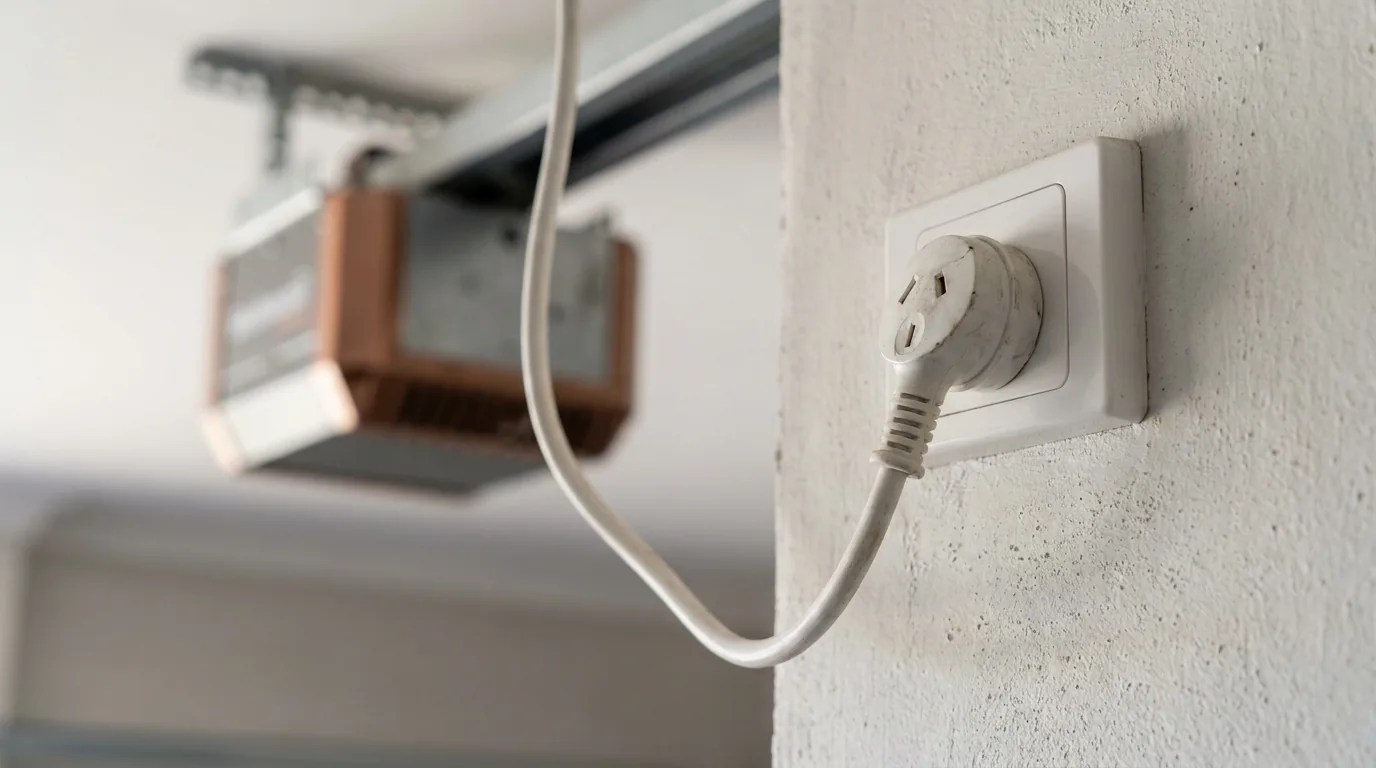
- **Plugging a modern garage door motor into an existing power point is NOT electrical installation work.** It is plugging in an appliance. No electrical contractor is required.
- **Adding a new power point in the garage IS electrical installation work.** Licensed electrical contractor, CCEI.
- **Hard-wiring a motor into the circuit IS electrical installation work.** Same requirement.
Most residential garage door motors in Perth are plug-in units, so most installations do not need a sparky. But some garages — particularly older ones, and rear-laneway garages on character homes — have no power point at all, and in that case one has to be installed properly by someone licensed to do it.
This cuts both ways, and both directions are worth watching for. An operator who quietly wires a motor in themselves is doing unlicensed electrical work in your house. An operator who insists you need an electrician when your garage already has a working power point is charging you for something you do not need. When we quote a motor installation, we tell you which of the two your garage is.
"Bonded" means nothing here
You will occasionally see Perth companies advertise as "licensed, bonded and insured". Bonding is an American construct — a surety arrangement common in US contracting — and it has no meaning or equivalent in Western Australian trade regulation. Its appearance is a fairly reliable sign that a page was written from an overseas template rather than from local knowledge.
So what should you actually check?
Since the licence question turns out to be a dead end, here is what genuinely tells you something:
- **Public liability insurance** — real, current, and they should be willing to show you the certificate. This is a substantive protection and it does exist here.
- **An ABN you can look up.** Free, instant, and it tells you the entity is real and how long it has been registered.
- **Whether they will put the diagnosis in writing** before the work, and the scope in writing after it.
- **Whether they test the auto-reverse.** A technician who does not check the door's only safety device is telling you something about the rest of their work.
- **Whether they are straight with you about the electrical question above.** It is a small thing that reveals a lot.
- **Association membership** — bodies such as the Australian Garage Door Association exist and some Perth firms belong to them. It is voluntary rather than regulatory, but it is at least verifiable.
None of that is as tidy as a licence number would be. But a licence number that does not exist is not a substitute for any of it, and we would rather tell you that than print a badge.