Garage Door Springs: The One Job You Never Touch
Let us be direct about the shape of this article. You will not find instructions here. Not because we want the work — though we do the work — but because a torsion spring is the one component on a garage door that has genuinely killed people, and a well-meaning how-to is how that happens.
What we can usefully tell you is how to recognise a failed spring, what not to do once you have, and why the job is what it is.
What the spring is actually doing
A domestic garage door weighs a great deal — on a double door, comparable to a small motorbike. You can lift it with one hand because the spring is carrying almost all of it. The motor is not lifting the door; the motor is nudging a balanced door along. That distinction explains nearly everything that follows.
To do that, the spring holds a large amount of stored energy, continuously, for years. Releasing that energy in an uncontrolled way is the hazard. It is not a matter of being strong or careful — it is a matter of having the correct winding gear, containment, and a sequence that does not permit a mistake.
How to tell your spring has gone
- **A single loud bang.** Often at night, frequently when nobody was near the garage — metal contracting as it cools is a common trigger. People routinely think somebody has broken in.
- **The door will not lift**, or the motor strains, groans and gives up.
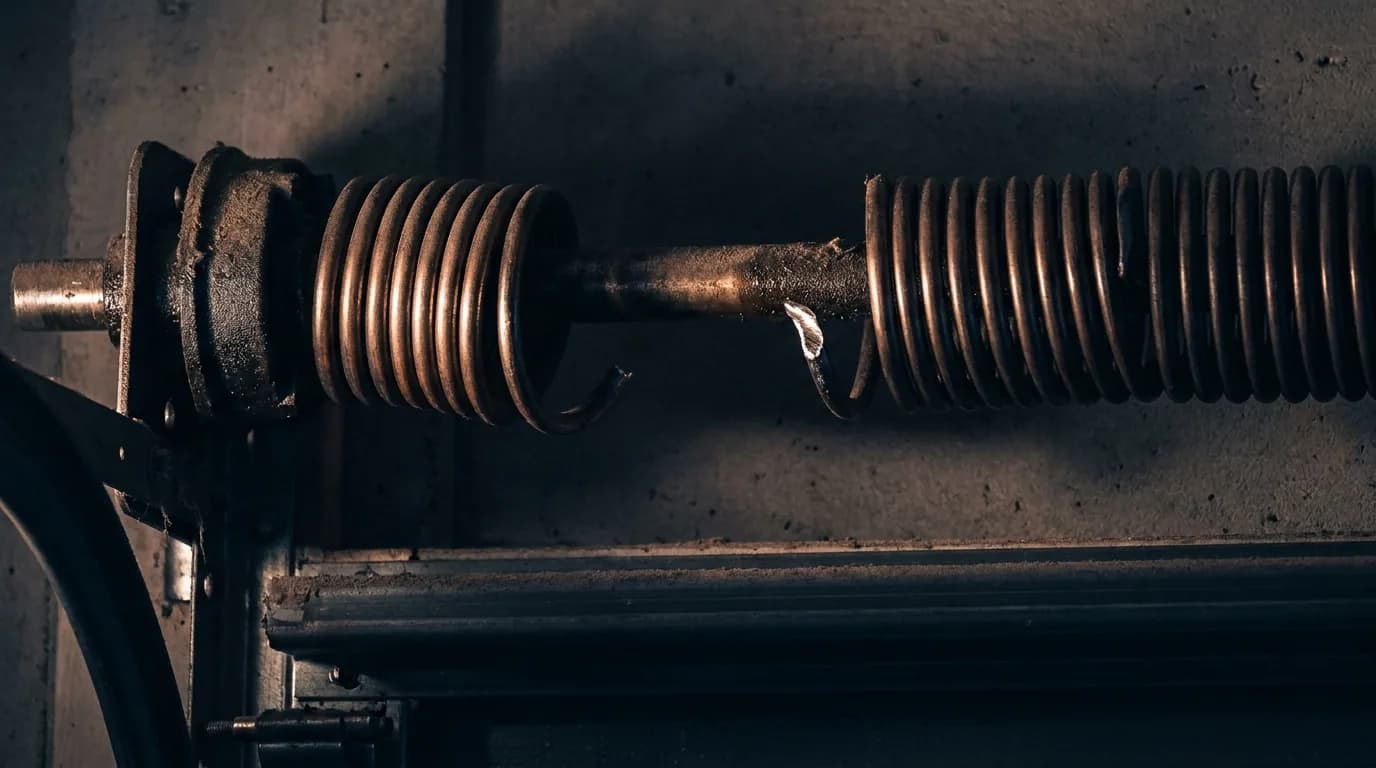
- **A visible gap in the coil.** On a torsion spring above the door, a failure usually leaves an obvious break with a gap of a few centimetres.
- **The door has become suddenly, dramatically heavy.**
- **The door drops fast** if it moves at all, or will not stay where you leave it.
- **On a roller door**, the equivalent symptom is a curtain that has become progressively heavier over months rather than failing in one moment — that is the axle spring losing tension rather than snapping.
What to do right now
- **Stop using the door.** Every attempt puts more strain into the motor, the cables and the guides.
- **Do not pull the manual release.** This one is counterintuitive and it matters: releasing the motor on a door with a failed spring means nothing is supporting the door's weight. It can drop.
- **Do not park under it**, and keep children and pets away from the opening.
- **If the car is inside and you need it**, say so when you call — that changes the priority, and it changes the advice.
- **Do not let anybody talk you through winding it.**
Why we replace both when only one broke
This comes up on nearly every job and it is a fair question. The second spring is the same age, has done the same number of cycles and carries the same fatigue history. Replacing one leaves you with a mismatched pair, an unbalanced door, a new spring carrying load it was not sized for, and — very reliably — a second call-out within months.
Doing both at once costs less than doing the job twice, and it leaves the door properly balanced, which is the actual objective.
Sized to your door, not to a chart
Springs are specified by wire size, inside diameter and length, against the door's actual weight. A spring chosen off a generic chart is either under-sprung — in which case the motor spends its life compensating and burns out early — or over-sprung, which is genuinely unsafe because the door wants to fly up.
This matters more than usual on heavier doors. A timber or thermopanel custom door can weigh substantially more than the steel door it replaced, and a standard package spring set on a heavy door is the single most common mechanical fault we find on architectural installations.
How long should a spring last?
Springs are rated in cycles, not years — one cycle being one open and one close. A standard spring is typically rated somewhere in the region of ten thousand cycles. A household using the door four times a day therefore gets several years; a household using it ten or twelve times a day gets considerably fewer, on exactly the same component.
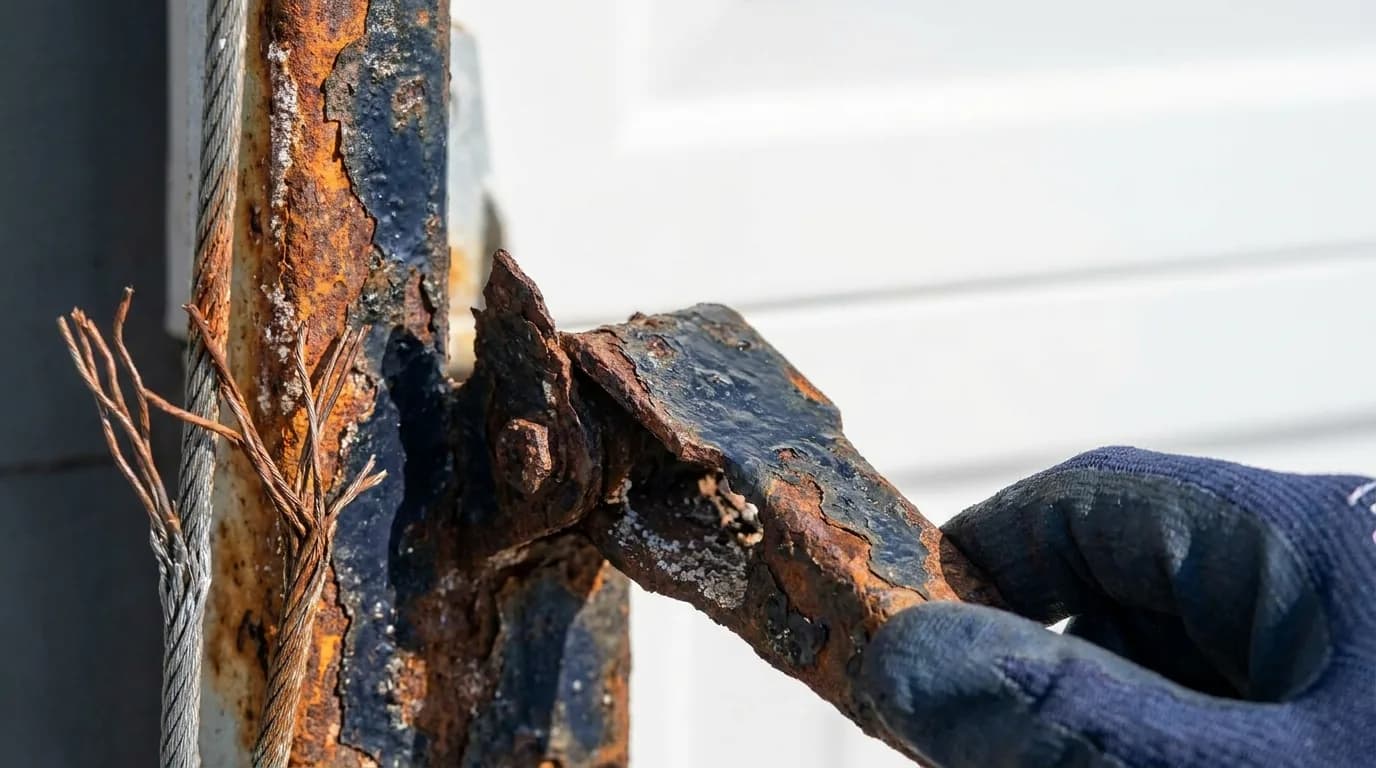
High-cycle springs exist and we fit them where a door is genuinely worked hard — a home with multiple drivers, a door that also serves a workshop, or a strata entry. Salt exposure shortens the life of any spring, which is why we offer corrosion-resistant options as standard on coastal addresses.
The practical takeaway: a spring that has quietly lost tension is far more common than one that has visibly snapped, and it is much cheaper to deal with. A door that has just started feeling heavier is worth looking at now, either as a spring replacement or as part of a scheduled service.