Salt Air and Your Garage Door: What the Fremantle Doctor Really Does to Perth Hardware
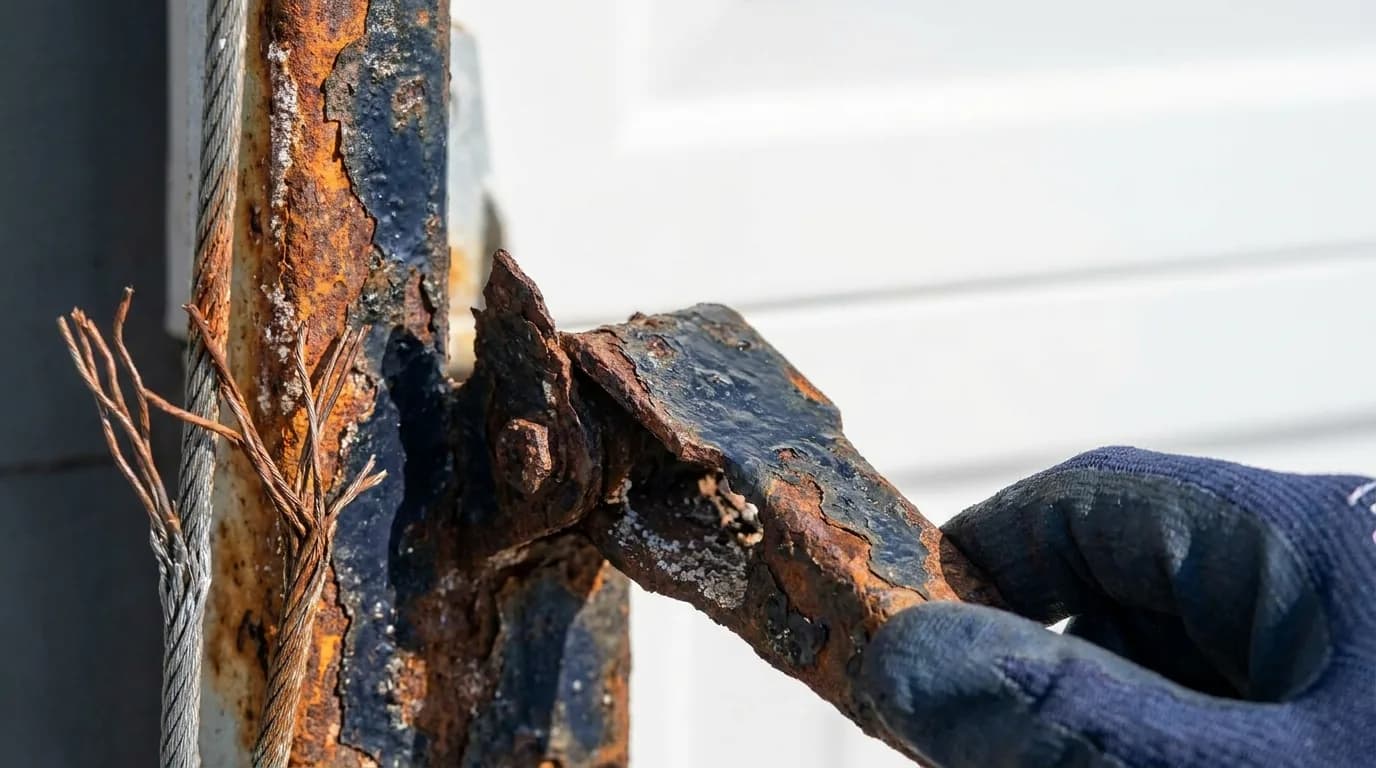
Most people in Perth's coastal suburbs first notice a salt problem when the door starts sounding different. Not worse exactly — just heavier, slower, a bit more effort from the motor. By that point the corrosion has usually been working for a couple of years, because salt does not start with the part you can see.
The afternoon sea breeze that arrives most summer days — the Fremantle Doctor — is a genuine, named, daily feature of this city, and it carries salt a long way inland. It does not stop at the beachfront suburbs. Homes several kilometres back from the water are still getting a salt load, just a smaller one.
What corrodes first, and in what order
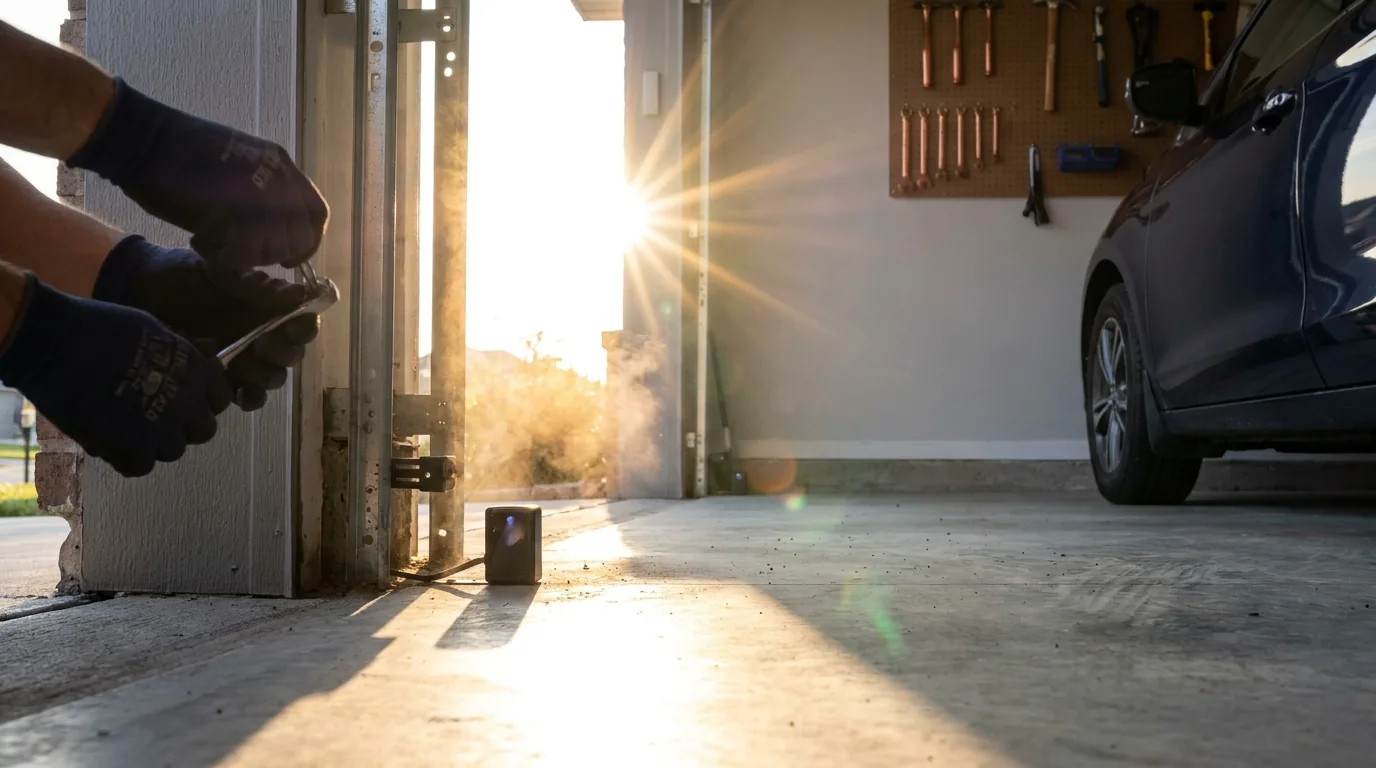
The pattern is consistent enough that we can usually predict what we will find before we open the garage. Salt attacks the components that are under tension, in motion, or both — because those are the parts whose protective coating is being continuously worked, flexed and abraded.
- **Torsion bars and spring ends** — under constant load, and the coil surfaces rub against each other on every cycle.
- **Flag brackets and bearing plates** — the fixings holding the whole assembly to the wall. These are the ones that matter most, because they are structural.
- **Cables and their terminations** — a multi-strand cable has enormous surface area, and corrosion starts inside the lay of the strands where you cannot inspect it.
- **Tracks, guides and rollers** — abrasion strips the coating, then salt gets to work on bare steel.
- **Steel hinges** on sectional doors, and **motor chains** on chain-drive units.
- **The bottom rail of a roller door** — and this one deserves its own section.
The bottom rail is the one that catches people out
On a roller door, the bottom rail is the horizontal section that meets the floor. It corrodes from the INSIDE face — the surface that points into the garage, which nobody ever looks at, and which stays damp longest because that is where water sits after rain and where condensation collects.
From the driveway the door looks entirely presentable. The powder-coated outer face is doing its job. Meanwhile the inside of that rail can be well advanced, and by the time rust shows through to the outside the section usually needs replacing rather than treating. This is the single most common thing we find on a coastal service that the owner had no idea about.
The good news is that the bottom rail is a separate component. If the slats above it are still sound, replacing just the rail returns the door to full service and restores the floor seal — a genuinely economical repair, and one of the more common roller door repairs we do in Perth's western and northern coastal suburbs.
Why the door itself outlasts its hardware
Modern pre-painted steel door skins are genuinely good. A Colorbond® curtain or a powder-coated sectional panel is engineered to hold up in exactly this environment, and it usually does. The hardware behind it is a different story — springs, cables, brackets and bearings are engineering components, not architectural finishes, and they are not specified with the same corrosion budget.
So the failure mode in a coastal Perth suburb is almost never "the door rusted out". It is "the door looked fine right up until the spring let go". That asymmetry is the whole argument for servicing on exposure rather than on appearance.
Sand does something different, and it does it at the same time
The same breeze that carries salt carries fine sand. Sand does not corrode anything — it abrades. It packs into roller door guide channels and into the bottom channel where the door seals, and then the curtain drags through it on every single cycle. The result is a grinding noise, accelerated wear on the slat edges and the guide, and — surprisingly often — a door that reverses before it closes because it genuinely is closing onto an obstruction.
There is a common and understandable mistake here worth naming: spraying lubricant into the guides. It feels like the right response to a grinding noise. It is not. Lubricant in a Perth guide channel collects the blown sand it was meant to help with and turns it into grinding paste, which is worse than dry. Clear the channel instead — and if the noise persists, it is telling you about the barrel bearing or the curtain running out of square.
So how often should a coastal door be serviced?
Here is where the industry is unhelpful. The two Perth-facing sources that publish most substantially on coastal corrosion give no interval at all — one recommends "regular checks" and "regular servicing", the other notes that even homes many kilometres inland are affected but declines to say how far or how often. Neither answers the two questions a homeowner actually has: does my house count as coastal, and how often, then?
We publish an interval. It is our recommendation, based on what we see fail and how quickly, and we state it as ours rather than dressing it up as an industry standard — because there is not one.
- **Within roughly 3 km of the coast: around every six months.** This covers the obvious beachfront suburbs and quite a few that are not obvious — Wembley Downs, Karrinyup, Mount Claremont and Doubleview all sit inside it.
- **Roughly 3–7 km: around every eight months.** The sea breeze still reaches the hardware; the full beachfront load does not.
- **Further inland: around every twelve months** for a typical household door.
- **Any door running more than about six to eight cycles a day: shorten it**, wherever you live. Cycles matter more than calendar time.
You will notice we have not given you a figure for how long a spring lasts on the coast versus inland. There is a widely-repeated claim along those lines circulating on garage-door websites, and we could not trace it to a primary source, so we are not going to repeat it as though it were data. What we can tell you is what we replace, where, and how often — which is why the interval above is expressed as a policy rather than as a statistic.
What actually helps
- **Rinse the door.** Fresh water, occasionally, especially after a stretch of strong sea breeze. Hand-washing with warm water and a mild detergent is the manufacturer-recommended approach and it genuinely removes salt rather than moving it around.
- **Ask for corrosion-resistant hardware** when something is being replaced anyway. Swapping to better-specified springs, fixings and bearings at the point of failure costs very little extra and is the cheapest upgrade available.
- **Clear the guides, do not grease them.** See above.
- **Get the bottom rail checked from the inside face.** If a service does not include this, it is not a coastal service.
- **Do not wait for a symptom.** The failure mode here is sudden, and it happens on hardware that looked fine from the driveway a week earlier.
If your door is in the coastal belt and has not been looked at in a couple of years, a garage door service is the cheapest thing you will do to it. And if a spring has already gone, do not lift the door and do not run the motor — that is a spring replacement, and it is the one job on a garage door that is genuinely dangerous.